Training your dog to stay alone - step-by-step for Swiss owners
For many Swiss owners, a dog that can't stay alone in a relaxed manner means stress: chewed-up furniture, complaints from the apartment building, a guilty conscience at the office. At the same time, it is almost unavoidable in everyday life to leave your four-legged friend alone for short periods of time. In this guide, I will show you step by step how to structure leaving your dog alone in a dog-friendly way - from the first few minutes to several hours. With realistic time frames, clear criteria and typical mistakes that you should avoid at all costs.
Table of contents ▼
- Why staying alone needs to be trained at all
- Basics for relaxed staying alone
- Step-by-step: Training your dog to stay alone
- Practical example from Switzerland
- When it makes sense to leave your dog alone - and when not
- Common mistakes when training your dog to stay alone
- Conclusion: This is what you do now
- Frequently asked questions about leaving your dog alone
- Leaving your dog alone is not an instinct, but must be built up in small steps.
- Start with seconds to a few minutes and only increase when your dog remains really relaxed.
- A camera, quiet zone and clear routines give you and your dog a sense of security.
- If your dog howls, panics or is very stressed, it is better to turn back the training and get professional help if necessary.
Why staying alone needs to be trained at all
Dogs are social animals and generally don't like to be left alone - even if they seem comfortable on the sofa. For them, being left alone means Caregiver gone, security gone, insecurity increased. Especially in densely populated Swiss communities with apartment buildings, barking or howling can quickly lead to neighborhood conflicts. Proper training therefore not only protects your dog from stress, but also you from getting into trouble with the landlord or council.
In addition, the everyday life of many owners requires regular absences: Work, shopping, doctor's appointments. A dog that has learned to accept these phases calmly can rest during these times instead of panicking. This reduces behavioral problems, promotes bonding and makes you suitable for everyday life as a team - whether in the city loft in Zurich or in the farmhouse in Emmental.
Basics for staying alone in a relaxed manner
To train your dog to stay alone safely, you need three things: a quiet, clearly defined area, reliable routines and an objective way to check how your dog is really doing. The area should be safe, clear and free from danger. Recurring routines before leaving take away nervousness. A camera (e.g. an old cell phone camera) shows you whether your dog is really asleep or whether he is whining and running up and down.
- Dog is physically and mentally adequately exhausted (but not completely overtired).
- Fixed resting place (bed, box, carpet) has been positively established and is willingly used.
- Home is secure: no cables, cleaning materials or leftover food lying around.
- Camera or audio recording set up to monitor behavior in your absence.
- Neighbors informed if noises occur briefly in the initial phase.
Depending on the dog and living situation, a cozy corner in the living room, a well-placed indoor run or a spacious box can serve as a quiet zone. On yards or in houses with a garden, some owners also use a well-protected dog kennel as an addition to the home, similar to the solutions from the professional dog equipment range for outdoor areas. It remains important: The dog should know the place positively and lie down there voluntarily before you leave him alone there.
Step-by-step: training your dog to stay alone
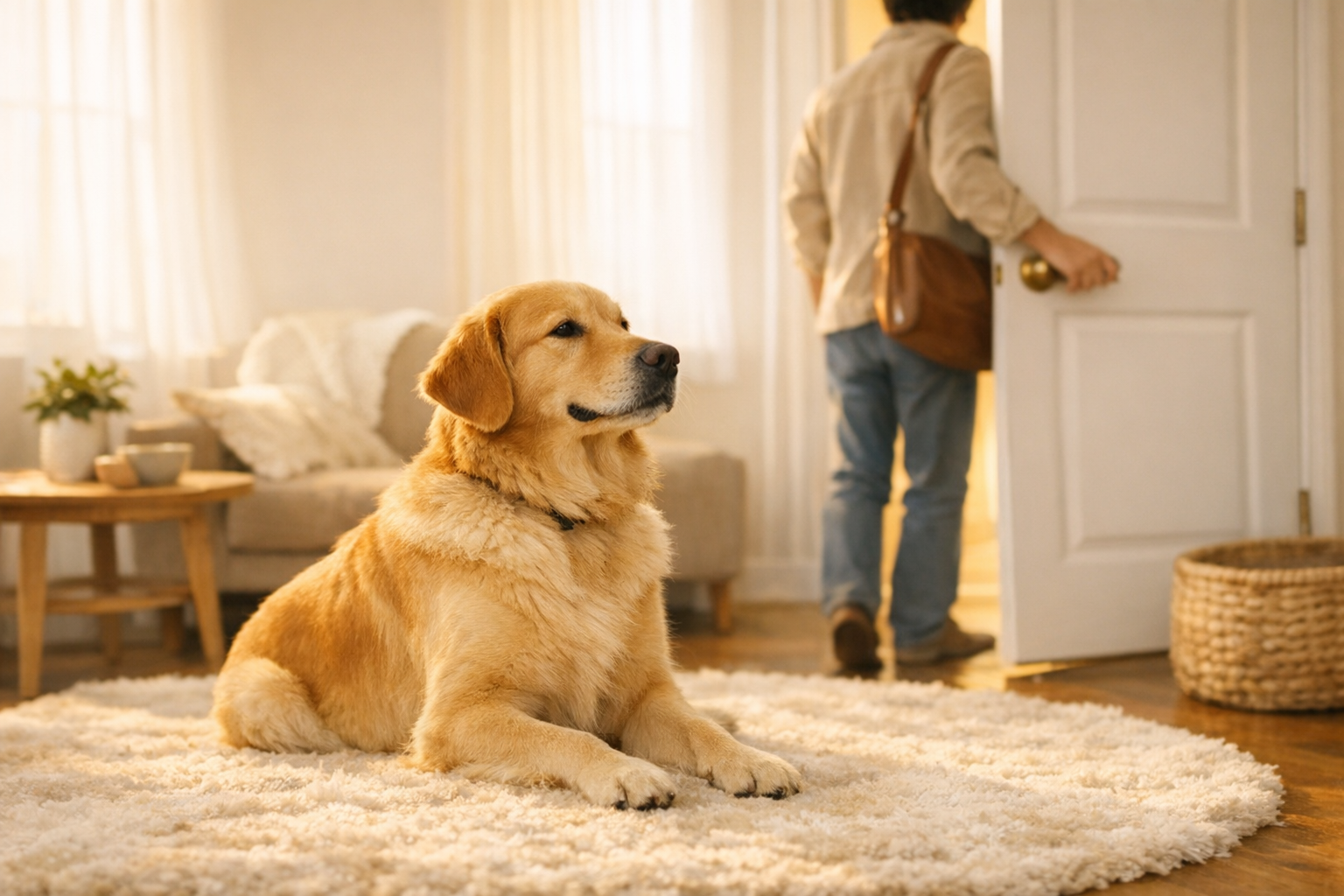
To build up your dog's ability to stay alone, proceed in clear, small steps: First, practise staying quiet with the door to the room closed while you are still in the apartment. Then leave the apartment briefly, return calmly and only increase the duration if your dog remains relaxed. In this way, he associates: "Being alone is boring and safe" - instead of "When the door closes, panic sets in".
Go for a quiet walk with your dog or do some short nose work, then take a 20-30 minute break. Never start immediately after a hectic game. Set him up in his resting place, give him a chew if necessary, sit down yourself and wait until he really calms down. Only then should you start the actual exercises.
Close the door to the room for a few seconds while your dog stays in his place and you are in the same room or right next to it. Open it again before he shows any signs of restlessness. Slowly increase to 1-2 minutes with short breaks in between. The goal is a dog that stays put when you close the door and does not comment on every noise.
Put your jacket and shoes on as normal, leave the apartment, count five to thirty seconds outside and come back in calmly. Ignore your dog for the first few seconds, then greet him in a friendly but relaxed manner. Only increase the duration if he has remained calm in the recordings during your absence.
Gradually build up the absences to 5, 10, 20, 40 and finally 60 minutes. Plan the increases in days, not hours. Vary the time of day and pre-program (walk, office day, shopping) so that your dog gets to know being left alone as a normal part of everyday life in Switzerland - regardless of whether it's a weekday or a weekend.
A good guideline: If your dog stays relaxed for the same length of time three to five times in a row, you can carefully extend the time. If he shows panting, howling, scratching at the door or destructive behavior, take at least one step back. It's better to slow down for a few days than to breed a real separation problem for months.
Use a simple camera app or an old smartphone that you point at the resting place. Many owners are surprised at how different the dog looks when no one is watching: Some that are very "dramatic" on return are actually sleeping the whole time - others appear calm but show clear stress on the recording. You should train according to what you see on the video, not according to your gut feeling.
Practical example from Switzerland
Family M. from an apartment building in Lucerne gets a one-year-old animal welfare dog from abroad. After the first few days, it turns out that as soon as someone leaves the apartment, the dog howls continuously and the neighbors complain. Instead of "just letting the dog howl", the family decides on structured training.
They set up a quiet corner in the living room, where the dog is given a big bed and an opportunity to chew. With the help of a camera, they discover that after two minutes of absence, he begins to circle nervously. So for two weeks they stick to very short periods of 10-30 seconds, spread out over the day, and work in parallel on relaxation signals and clear routines. Only when the video shows that the dog lies deeply relaxed for 2-3 minutes do they increase to 5, then 10 and 15 minutes.
After about eight weeks, the dog can stay alone for a relaxed 90 minutes - enough for small shopping trips and appointments. For longer working days, they organize a dog sitter in the neighbourhood. The pressure from the neighborhood decreases because there is practically no more whining, and the family reports that the dog seems more balanced overall since he has learned to really sleep during this time.
When staying alone makes sense - and when it doesn't
Alone time training is useful for most dogs, but there are limits to its use. For healthy, adult dogs in stable conditions, it is often possible to stay alone for a few hours without any problems - provided that the training has been carefully structured. For very young puppies, dogs with medical problems or animals with already pronounced separation anxiety, however, longer periods alone are unsuitable or can only be justified with professional supervision.
When structured training to stay alone is worthwhile
It is ideal if you have medium to long-term planned absences that are not too long: Office part-time, shopping, sports. Your dog is physically healthy, can calm down in everyday life and only shows uncertainty when you first leave. In these cases, orderly training puts you both in a comfortable situation and also complies with Swiss animal welfare regulations, which prohibit excessive isolation but allow short, reasonable periods alone.
When other solutions are better
If your dog is already panicking, injuring himself, destroying your home on a massive scale or you have to leave him alone for eight to ten hours five days a week, normal training is usually not enough. In such situations, combinations of dog day care, dog walkers, family support or a job with a dog are much fairer to the animal. On a farm or in an agricultural environment, a safe outdoor area can bridge the gap - but here too, regular social contact is needed, not just "safekeeping".
Common mistakes when training to stay alone
Many problems are not caused by "difficult dogs", but by unclear procedures. Typical mistakes are: increasing too quickly, unreliable times, dramatic farewells or "ambushes" on return. It is equally counterproductive to punish the dog for fearful reactions - he then only learns to suppress emotions, but not to feel really safe.
- Too big a leap: Going from five minutes straight to an hour is too much for most dogs.
- Restlessness before leaving: Hustle and bustle, multiple jacket-on jacket-off increases nervousness.
- Unclear return: Excessive joy on returning home increases the "ramp-up".
- Ignored warning signals: panting, drooling, destroying or uncleanliness are serious signs of stress.
- Inappropriate environment: Too much noise in the stairwell or road traffic directly outside the window keep sensitive dogs in a state of constant tension.
If your dog reacts strongly to even a second's absence despite very small-step training, shows physical symptoms such as diarrhea or self-harming behavior or you are in a tense living situation with warnings from neighbors or the administration, get professional support early on. A vet specializing in behavioural medicine or a qualified trainer can clarify whether there is a separation anxiety that requires treatment.
Conclusion: Here's what you can do now
Start with a clean setup: safe resting place, camera, relaxed starting situation. First practise closing the door in the home, then ultra-short absences of seconds to a few minutes and only increase when your dog remains visibly relaxed. Plan the development in weeks, not days, and combine the training with fair forms of supervision if your working hours are longer. As soon as you notice that your dog reliably survives several short phases calmly, you can work towards your desired duration - always with your dog's well-being as the primary guideline.
Frequently asked questions about leaving your dog alone
When can a puppy be left alone at home in Switzerland?
A puppy should practically not be left alone for the first few weeks after moving in, except for seconds to a few minutes during training. Realistic alone times of 30-60 minutes are often only possible from around five to six months of age, provided the puppy has been well supervised and does not show any anxiety reactions. Longer absences in the first year should be covered by a caregiver or daycare if possible.
How long can a dog be left alone according to Swiss animal welfare regulations?
The Animal Welfare Ordinance does not specify a fixed number of hours, but makes it clear that dogs need sufficient social contact every day and must not be kept in isolation for long periods of time. In practice, many experts recommend a maximum of four to six hours at a time for healthy, well-trained dogs - and even then only if the dog has shown that it really does sleep through this time in a relaxed manner and the rest of the day is spent being active and social.
What do I do if the dog only barks as soon as he hears noises in the stairwell?
Noise management is key in apartment buildings. Create a quiet zone away from the front door, use privacy screens or closed doors if necessary and also work on a "quiet signal" that you initially set up in your presence. Background noises such as soft music or a radio program can help to mask sudden noises. If your dog still explodes at every step in the stairwell, targeted training with staged noises and rewards for calm behavior is worthwhile.
Does it make sense to keep two dogs to help them stay alone?
A second dog can make it easier for them to stay alone, but it doesn't solve any real separation anxiety from humans. In many cases, you then have two dogs with the same problem - plus double the responsibility and costs. A second dog is particularly useful if you already have a stable, relaxed first dog, your living conditions are suitable and you are aware that the new dog will also have to learn to stay alone separately.
Does food or a filled Kong help the dog to stay alone better?
A stuffed Kong or chew can make it easier to get started with staying alone, but it is no substitute for structured training. Many dogs only eat as long as they still feel safe - if the mood changes, treats are left untouched. Therefore, use such aids, especially in short sessions, to reinforce the positive mood and observe on camera whether your dog is really relaxed when chewing or just eating frantically because he is stressed.