Traveling with a dog in Switzerland: car, public transport or motorcycle - what is allowed?
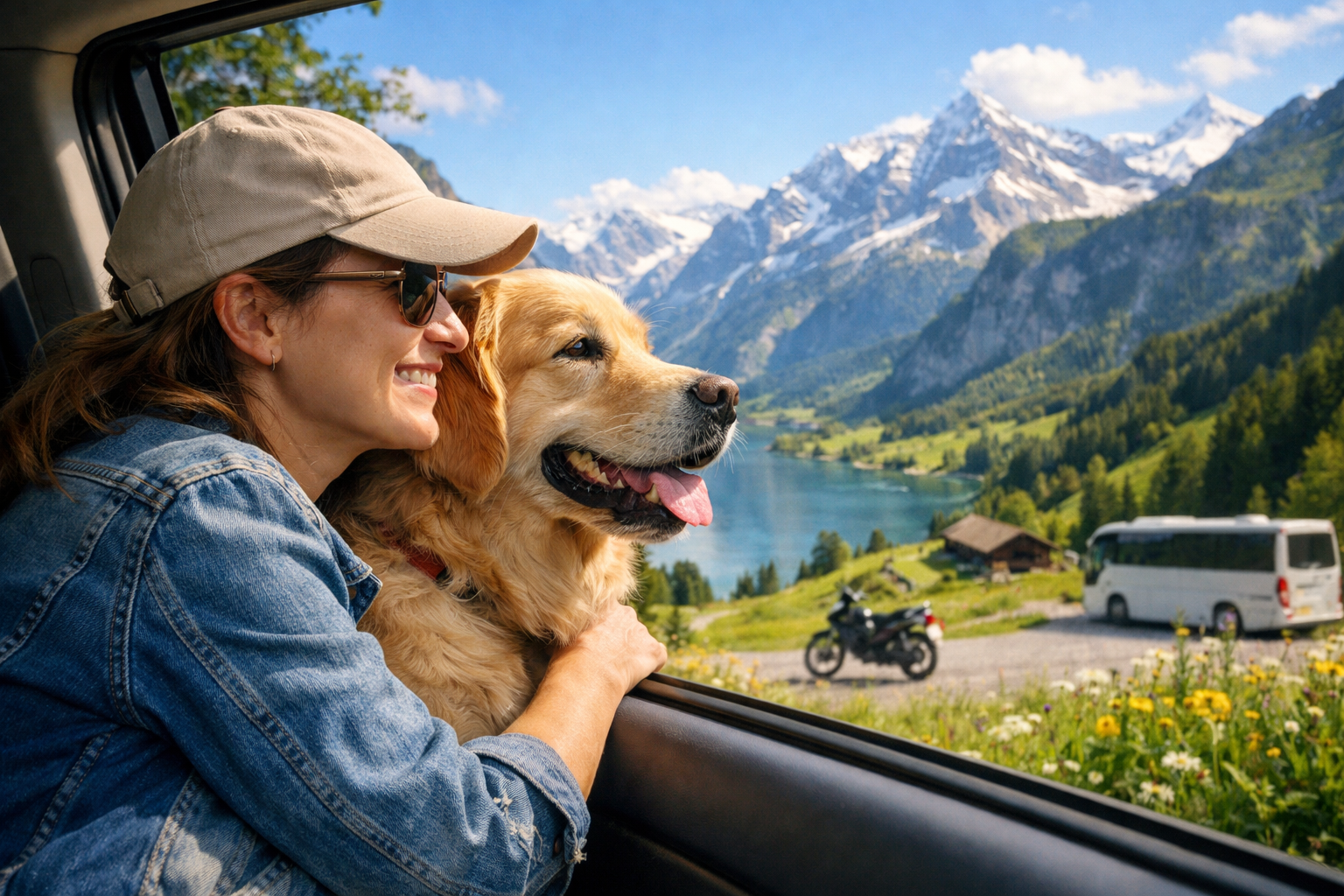
Anyone traveling with a dog in Switzerland is quickly faced with practical questions: Can the four-legged friend simply sit on the car seat? How strict are the rules on public transport? And is it even permissible to take your dog on a motorcycle or is it just a tricky idea? This guide summarizes the most important legal key points and safety aspects, shows which transport options work in everyday life and where the limits lie - so that you can make responsible decisions for yourself, your dog and other road users.
Table of contents ▼
- In the car, the dog must be secured in such a way that it does not endanger the driver - a box, belt or sturdy separating grid are useful.
- On public transport, depending on the provider, there are clear rules on leads, muzzles and compulsory tickets; planning prevents stress.
- Transport on a motorcycle is legally tricky and is only really worth discussing with very good protection, a calm dog and short distances.
- For most dogs, cars or public transport are much safer and more animal-friendly than any motorcycle solution.
Dogs in cars: what is allowed and what makes sense?
In Switzerland, a dog is allowed to travel in a car if it is secured in such a way that the driver is not distracted and the dog is not thrown through the passenger compartment during a braking maneuver. The law does not stipulate a specific type of securing, but in practice, closed transport boxes, tested safety harnesses or stable separating grilles between the trunk and the passenger compartment have proven their worth.
Legally, the dog is regarded as a load that must be secured "in accordance with regulations". Unsecured dogs or animals on the lap are considered to be inadequately secured and can be objected to during an inspection - but above all they represent a considerable risk for all occupants. For Swiss conditions (a lot of highway, mountain roads, winter conditions), it is worth having a solution that holds reliably even under emergency braking and lateral forces.
Suitable safety systems in the car
For everyday use, three main variants have become established in cars, which differ depending on the type of vehicle, dog and budget.
- Transport box in the trunk or on the back seat: Particularly widespread in estate cars and SUVs; protects dogs and people well if the box is stable and correctly secured.
- Car safety harness with seat belt: For dogs that like to be close to passengers; a harness with wide straps and tested load capacity is important.
- Firmly bolted separating grid: Suitable for larger dogs in the trunk; in combination with a non-slip base and, if necessary, a rear seat net.
- Choose a safety solution that suits the dog and vehicle (box, belt, grid).
- Fit the crate or harness according to the manufacturer's instructions and check it regularly.
- Gradually get your dog used to getting into the car and traveling quietly.
- Never leave your dog in a closed car in summer - it can quickly become too hot, even in the shade.
- Drive particularly defensively on mountain roads and in winter to avoid sudden movements.
Particularly in Switzerland with its changeable weather, mountain passes and tunnels, it makes sense to think about comfort as well as safety: an absorbent pad if the coat is wet, sufficient fresh air without draughts, and regular breaks for loosening and drinking on longer journeys. For sensitive or older dogs, non-slip ramps can make boarding high vehicles much easier.
Dogs on public transport: rules on trains, streetcars and buses
Dogs are generally allowed on public transport in Switzerland. However, the rules that apply depend on the respective transport company and the size of the dog. Small dogs up to 30 cm at the withers may travel free of charge, provided they are carried in a transport box, basket or similar suitable container under the seat. Larger dogs generally require a ticket at half the price of 2nd class or the minimum fare, must be kept on a lead and must not endanger or hinder other passengers. It is therefore worth taking a look at the current conditions of carriage of the respective provider, especially for new routes.
In practice, a distinction is usually made between "small enough for a transport box" and "larger dog on the floor next to the owner". The dog should be placed in such a way that it does not block the passageway - this often means a place under the seat or in the footwell. At peak times or on busy trains, you may have to move your dog to certain areas such as boarding zones or multi-purpose compartments. If the dog is gradually accustomed to noises, announcements, other people and confined spaces, journeys on public transport are usually much more relaxed.
How do I prepare my dog for public transport?
To ensure that the first trip on public transport doesn't end in stress, it helps to gradually get your dog used to noises, confined spaces and strangers.
Take your dog to a quiet stop or an empty tram/train (e.g. terminus) without traveling immediately. Reward calm behavior and get the dog used to doors, smells and surfaces.
Start with very short journeys at off-peak times. Provide a comfortable place to lie down, keep your dog away from doors and entrances and keep rewarding him for lying or sitting in a relaxed position.
Gradually increase the duration and distraction. Practice sit and down signals in the vehicle, pay attention to polite behavior towards fellow passengers and repeat the transport rules (leash, muzzle if necessary, ticket) before each journey.
For families and owners in apartment buildings, public transport can be a good alternative to the car - especially if parking spaces are scarce or children are traveling at the same time. It is important to combine the dog's needs (space, peace and quiet, distance from other dogs) with the expectations of other passengers in terms of cleanliness and consideration. A blanket or mat as your "own space" helps many dogs to settle down better.
Dogs on motorcycles: legally possible, practically sensible?
There is no explicit ban on transporting a dog on a motorcycle in Switzerland. However, road safety and vehicle control must be guaranteed at all times, and the dog must be transported in such a way that neither the animal nor other road users are endangered. In practice, however, this is only justifiable within very narrow limits: the dog needs a stable transport solution, adequate wind and hearing protection and very careful familiarization. For many dogs, the combination of noise, airstream and vibrations is simply too stressful.
Typical transport options are closed top cases with ventilation, sturdy biker backpacks or specially designed sidecars. Regardless of the solution, the responsibility remains with the rider: the dog must not be able to fall out, must not impair control of the vehicle and must be transported in compliance with animal welfare regulations. If you are still at the beginning of your motorcycling career, you will benefit from solid basic training in safe motorcycle handling and typical traffic situations, for example as part of a basic motorcycle course in Zurich.
Even if a transportation solution works technically, it is not automatically suitable for animals. Dogs are less able to assess heat, wind, cold and noise than humans. Particularly on mountain passes, in the rain or in tunnels, stress can quickly become extreme. Clarify honestly whether the motorcycle transport is reasonable for your dog - and it is better to stop if he shows signs of fear or stress.
Realistically, the motorcycle is only an option for short distances with very well-prepared dogs with strong nerves and experienced drivers - and even then it is more of an exception than a routine. For older, sick, anxious or very large dogs, this type of transportation is hardly practical. In many cases, it is more animal-friendly to take the dog to its destination in a different way or not to take it with you at all.
Decision-making aid: car, public transport or motorcycle?
For most dogs in Switzerland, the car is the most flexible and safest transport option, provided the dog is properly secured and the climate in the vehicle is kept under control. Public transport is well suited to well-socialized, noise-resistant dogs and owners without their own car. The motorcycle remains a niche solution for special situations and particularly experienced human-dog teams; in many cases it is not the best choice for animal welfare and safety reasons.
When is the car the best choice?
The car is particularly suitable for dogs that value stability and peace and quiet or have health restrictions. You can plan breaks flexibly, control the climate (heating/air conditioning) directly and have space for a crate, water and accessories. For regular trips to the vet, to the farm or to the mountains, the car offers the greatest control over the surroundings and duration.
When is public transport worthwhile - and when is it not?
Public transport is a good option in cities and conurbations if parking spaces are scarce or you want to be environmentally conscious. It is suitable for socially acceptable, people- and dog-tolerant animals. For very noise-sensitive dogs, dogs with claustrophobia or those that run uphill quickly, however, public transport can be more stressful than beneficial.
The motorcycle rarely offers a real advantage for the dog in everyday life: there are hardly any opportunities to retreat, the climate cannot be regulated and even small driving errors have a direct effect. If taking your dog with you is nevertheless an issue, it should be considered an exception - and only after careful preparation, veterinary clarification and an honest self-assessment of your own driving experience.
Plan a "Plan B" for every type of transportation: a spare lead and muzzle in your rucksack for public transport, a blanket and water in the car, or a person who will take the dog by car in bad weather if you continue by motorcycle. This way, you will still be able to act in the event of disruptions, breakdowns or changes in the weather.
Regardless of the means of transportation you choose, it is worth considering your own surroundings: In apartment buildings, it is often easier to travel by public transport with your dog than to look for parking spaces every day. On farms or remote farms, on the other hand, the car is almost indispensable for transporting dogs and equipment at the same time. The decisive factor is always the combination of dog type, place of residence, route length and personal experience in traffic.
Conclusion: Safe and suitable for everyday travel
Choose your means of transport primarily based on safety and reasonableness for your dog - not on your own desire for mobility or speed. First set up a really safe transportation solution in the car or check whether your dog can travel comfortably by public transport. The motorcycle should only be used for short, well-prepared exceptions, if at all. Observe your dog closely, adjust the general conditions (climate, breaks, securing) and seek professional advice if you are unsure, for example from vets, dog trainers or driving instructors with experience in transporting animals.