Maintenance and Care: How to Keep Your Electric Fence Functional for a Long Time
An electric fence that suddenly loses power, a sagging wire, or rotten posts – such problems rarely appear out of nowhere. Most often, it's just a matter of a few simple but consistently executed maintenance steps. Those who systematically maintain their fence save time, money, and stress – and ensure that animals are safely enclosed and neighborhood conflicts don't even arise. This guide shows you how to keep your pasture fence fully functional in Swiss practice.
Table of Contents ▼
- Fundamentals: What Pasture Fence Maintenance Really Means
- Regular Checks Throughout the Year
- Typical Mistakes and How to Avoid Them
- Decision: What's Worth Repairing – and What Should Be Replaced
- Practical Checklist for the Start of the Season
- Conclusion: How to Keep Your Pasture Fence Reliable
- Frequently Asked Questions About Pasture Fence Maintenance
- Weekly visual inspection at a minimum; more often with young animals or near roads.
- Energizers, grounding, and connections are the most common weak points – inspect these particularly carefully.
- Moist Swiss soils require good grounding and clean insulators, otherwise, herding safety decreases.
- Beyond a certain level of damage, replacement is more economical and safer than constant patching.
Fundamentals: What Pasture Fence Maintenance Really Means
In practice, pasture fence maintenance and care mean three things: first, regular visual inspections; second, early detection of wear and tear; and third, consistently fixing small defects before they become safety risks. Those who incorporate these points into a simple routine plan prevent power outages, escapes, and material damage – whether it's an electric fence, a net, or a permanent fence system.
Maintenance therefore includes not only walking the fence line but also checking the energizer, grounding, connections, gates, and crossovers. In Switzerland, climatic stresses also play a role: moisture, frost, snow, and strong sunlight cause plastic to age, wood to rot, and metal to corrode. Good maintenance considers these factors and plans targeted spring, summer, and autumn checks.
Regular Checks Throughout the Year
Professional maintenance of your pasture fence consists of four components: a quick routine check in everyday life, a weekly functional check with a fence tester, seasonal inspections, and a thorough overhaul when moving pastures. In everyday life, often just a glance at sagging sections, broken posts, or animals grazing "too boldly" near the fence is enough. Weekly, however, you should systematically check the entire fence line, all gates, and the energizer, including grounding – this is the only way the fence remains functional in the long term.
The following division has proven effective for structured maintenance:
- After each animal change / grazing period: Quick check of gates, corners, visible connections.
- Weekly: Measure voltage with a fence tester, remove vegetation at critical points.
- Monthly: Inspect posts, insulators, knots, and connectors more closely, replace damaged parts.
- At the beginning and end of the season: Thorough overhaul of the entire system, including energizer and grounding system.
Walk the fence calmly, ideally along the inside. Look for sagging sections, crooked posts, loose insulators, damaged strands or tape, and vegetation growing into the fence.
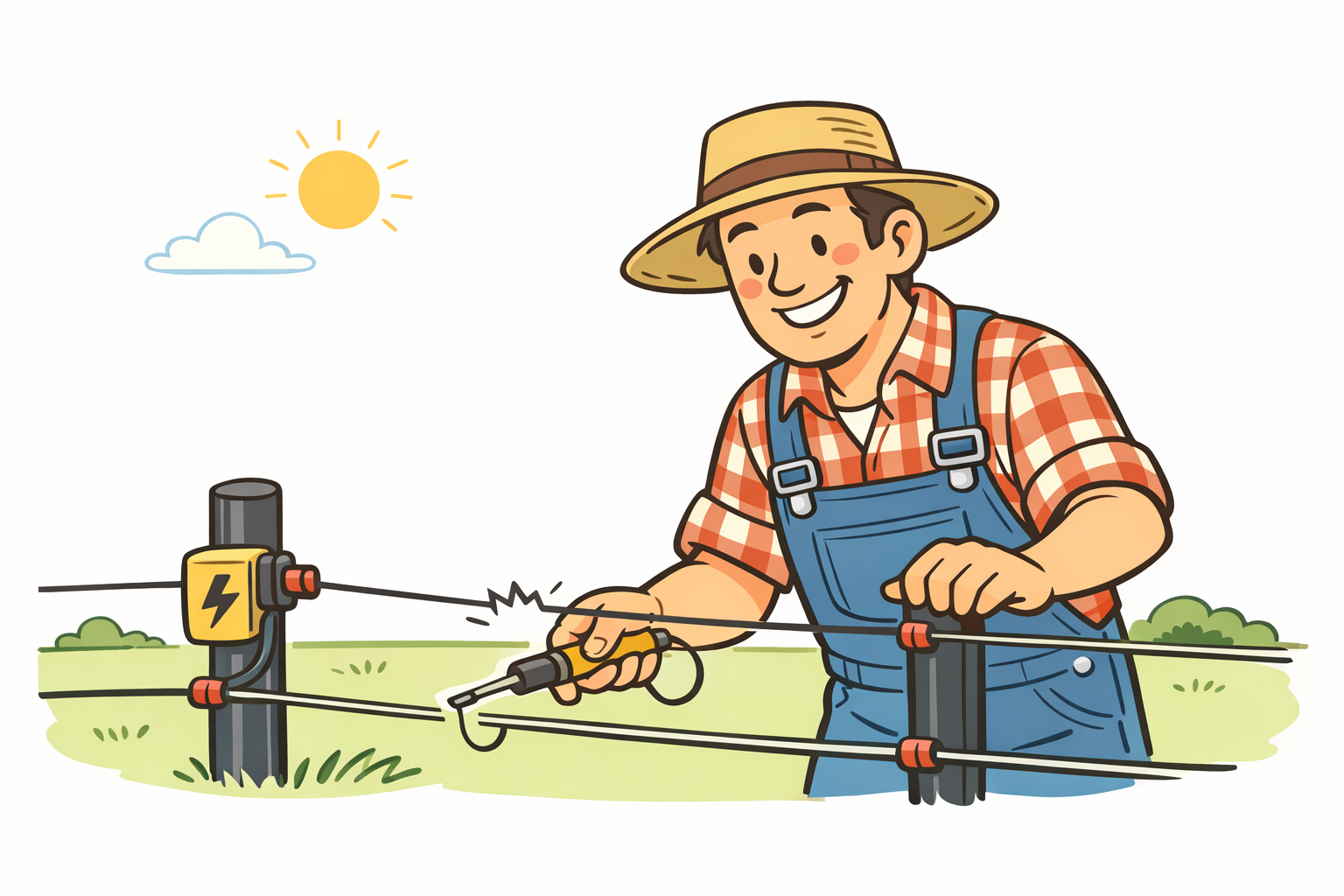
Check the energizer, grounding, all cable connections, and gates. Use a fence tester at several points to measure if the voltage is sufficient, and compare the value with that at the energizer.
Repair any damage found immediately: straighten or replace posts, change insulators, neatly connect strands, trim vegetation. Avoid temporary fixes whenever possible, as they tend to become permanent.
For electric netting, pay additional attention to straight posts, proper ground contact of the ground wires, and tight net tension. On slopes, ensure that the net does not form "steps" where animals could get tangled or where electrical bridges to the ground could form.
Typical Mistakes and How to Avoid Them
Most problems with pasture fences arise not from "poor material" but from recurring maintenance errors: insufficient grounding, bad connections, inadequate voltage, or chronic vegetation. Addressing these points significantly reduces escapes and complaints. Especially with young animals, ponies, or goats, one bad experience with a weak fence is enough for them to consistently test it.
Common Maintenance Errors in Electric Fences
In practice, similar errors repeatedly occur that can be avoided with little effort:
- Insufficient grounding: Too few ground rods, old or poorly driven ground rods, loose ground connections.
- Corroded clamps and connections: Verdigris, rust, or loose screw connections increase resistance and lower herding voltage.
- Heavy vegetation in the lower fence area: Wet grass conducts electricity, especially during rainy Swiss summers.
- Mixing unsuitable conductors: Different qualities of polywire, tape, and wire without appropriate connectors lead to voltage loss.
- Damaged insulators: UV-damaged, cracked insulators cause leakage currents and arcing in wet conditions.
An electric fence that audibly "ticks" or visibly sparks when wet is a clear warning sign. Often, an insulation problem or insufficient grounding is present. Such symptoms must not be ignored – they are not only a safety risk for animals but can also worry neighbors and, in extreme cases, lead to fires.
Even with permanent wooden fences, typical maintenance errors occur: posts without adequate wood preservation in the ground, insufficient distance between boards and the ground (rotting), rusting fittings, or unsecured gates. At the latest when wood becomes soft or screws no longer hold, replacement is due – selective "cosmetics" will then hardly provide any stability.
Decision: What's Worth Repairing – and What Should Be Replaced
Not every damage to a pasture fence requires immediate complete renovation. Often, replacing individual posts, insulators, or connections is enough to restore full function. The overall condition is crucial: if repairs are made in many places simultaneously, maintenance effort and the probability of failure increase. In such cases, it is often more economical and safer to consistently renew a section rather than repeatedly investing time in repairs.
To help with your decision, you can refer to the following questions:
- How old is the material? Heavily aged tape, polywire, or netting with many breaks are usually due for replacement.
- How many areas are affected? Repair individual damages; numerous damages suggest renewing sections.
- Which animals are being kept? For valuable breeding or escape-prone animals (e.g., horses, cattle, sheep near roads), a "robust" solution is clearly preferable.
- Where is the pasture located? Near roads, hiking trails, or residential areas, a reliably stable fence is mandatory – also for liability reasons.
For gates and crossovers, high-quality, corrosion-resistant technology is particularly worthwhile. Robust gate systems with suitable gate rollers, latches, and gate handles significantly reduce disruptions in daily handling of animals. Corresponding solutions can be found, for example, in the category for electric fence gates, which is specifically designed for durable and secure entrances and exits.
only individual posts, insulators, or conductor pieces are defective, the rest of the system still appears stable, and the electrical performance is correct. Ideal if you have a younger fence system and want to eliminate specific weather-related or mechanical damage (e.g., from machinery).
material is heavily aged, many temporary connections exist, or safety requirements have increased – for example, due to more traffic, new animals, or stricter operational guidelines. In such cases, a clearly planned replacement is more economical than continuous repairs.
Practical Checklist for the Start of the Season
Before turning out animals in spring or moving them to a new pasture, a structured start-up check is worthwhile. This ensures that your pasture fence functions reliably from the outset and that you are not dealing with emergency repairs in the middle of the season. Use the following checklist as a guide and adapt it to your animals, areas, and farm size.
- Check energizer for external damage, cables, and connections, perform a test run.
- Check grounding: number of ground rods, connections, depth of drive, and signs of corrosion.
- Check fence conductors (tape, polywire, wire, net) for breaks, knots, twists, and sagging.
- Inspect posts: stability, rot in wood, UV damage in plastic, anchoring.
- Check insulators for cracks, deformations, and moisture marks, replace if necessary.
- Test gates and crossovers: mechanics, gate handles, latches, gate springs, and electrical connection.
- Remove vegetation, especially in the lower fence area and around ground rods and gates.
- Measure and document voltage at several points with a fence tester (define target value).
Especially in the Swiss spring with changing ground conditions – from frozen morning to softened afternoon – it is particularly worthwhile to keep an eye on the grounding. Where ground rods are in standing water or only partially driven, voltage losses can occur. A clean, adapted grounding system is the basis for a permanently functional pasture fence.
Briefly document your measurements and observations in your calendar or on a simple fence map. This way, you can identify sections that repeatedly cause problems, better plan material requirements, and specifically upgrade in case of recurring issues – for example, with more conductive netting or better gate systems.
Conclusion: How to Keep Your Pasture Fence Reliable
Rely on clear routines instead of occasional "firefighting." Establish fixed inspection rhythms, regularly measure voltage, and treat the energizer, grounding, gates, and crossovers as safety-critical points. Repair small defects immediately, consciously decide for a section replacement in case of cumulative damage, and plan the start of the season with a structured checklist. This way, your pasture fence will remain functional in the long term – and your animals will safely stay where they belong.